

No special precautions or preparations are needed. Fasting is not required as well.
12ml of blood from the expected mother
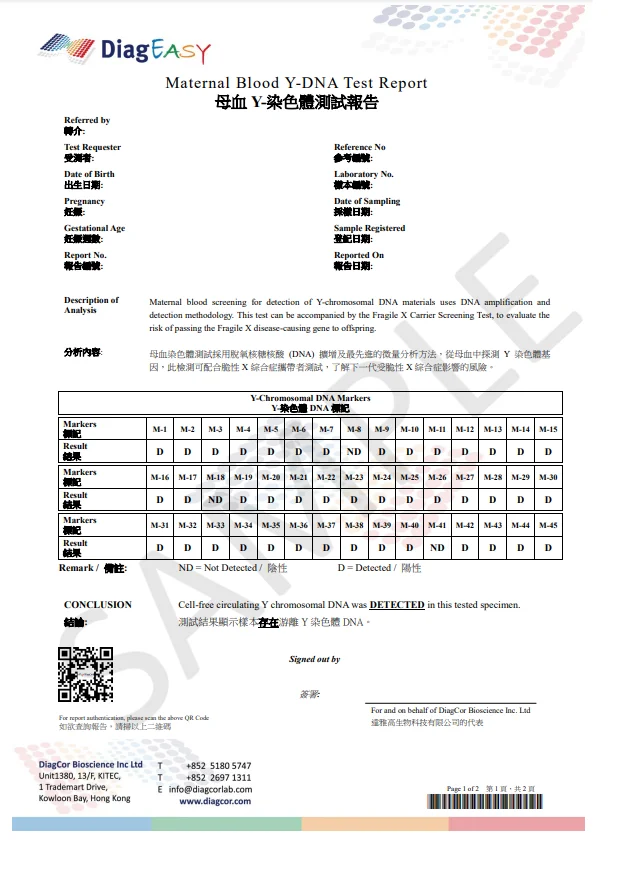
For Maternal Blood 45 Y-DNA Test report:
如受測者接受過器官移植,便不能做這個Y染色體測試。(達雅高將不接受此樣本作化驗)
No special preparation is required, no fasting.
In about 18 working days after DiagCor receive all the samples.
10 weeks pregnant or above (subject to ultrasound examination)
No special preparation required, no fasting required
Surrogacy、Fetal proportion should not be less than 2% (not less than about 6-8 weeks of pregnancy) and Fraternal twins
No special preparation is required, no fasting.
If the subject has undergone organ transplantation, they cannot accept this test. (DiagCor will not accept this sample for testing)
1. Someone in the family has symptoms of tremor after the age of 50
2. The family has a history of autism
3. The family has a history of intellectual development or growth retardation
4. The family has a history of fragile X syndrome
5. The family has a history of premature ovarian failure or premature menopause
6. Worried about the child suffering from fragile X syndrome (expectant mother / pregnant lady)
** Apart from expectant mothers who can receive the fragile X carrier test to protect the health of the next generation, it can also be suitable for all women who are preparing for pregnancy as part of the pre-marital examination
It is recommended that you check with your doctor first. For pregnancy on or after 20 weeks we can also provide screening (MP2) and/or a short-term prediction (MPX). The report will be available within one working day.
Studies show that pregnant women with pregnancy toxemia are twice as likely to also have cardiovascular disease and hypertension than other mothers. Premature babies generally have poor resistance and immunity, which can lead to stunting.
Women who have suffered from pregnancy toxemia during pregnancy in the past have higher chances of developing it again in any subsequent pregnancy. But because of individual differences, early pre-eclampsia screening is recommended for every pregnancy in between 11- and 14-week.
If risk is low, it means that you are less likely to develop pregnancy toxemia during pregnancy. Conversely, if you have a high risk means that the chances of developing the disease during pregnancy are quite high. Doctors can start the intervention earlier and monitor pregnancy more closely to reduce the impact of the disease to the mother and the fetus.
It is especially recommended for pregnant women from the 11th to the 14th week of pregnancy to test. If you can be found as a high-risk pregnant woman before the 14th week, you can seize the golden time of treatment and reduce the premature birth rate by up to 80%.
This screening meets the international standards for early pre-eclampsia (refer
to the latest guidelines of FIGO and FMF), and can accurately predict the risk of
developing pregnancy toxemia.
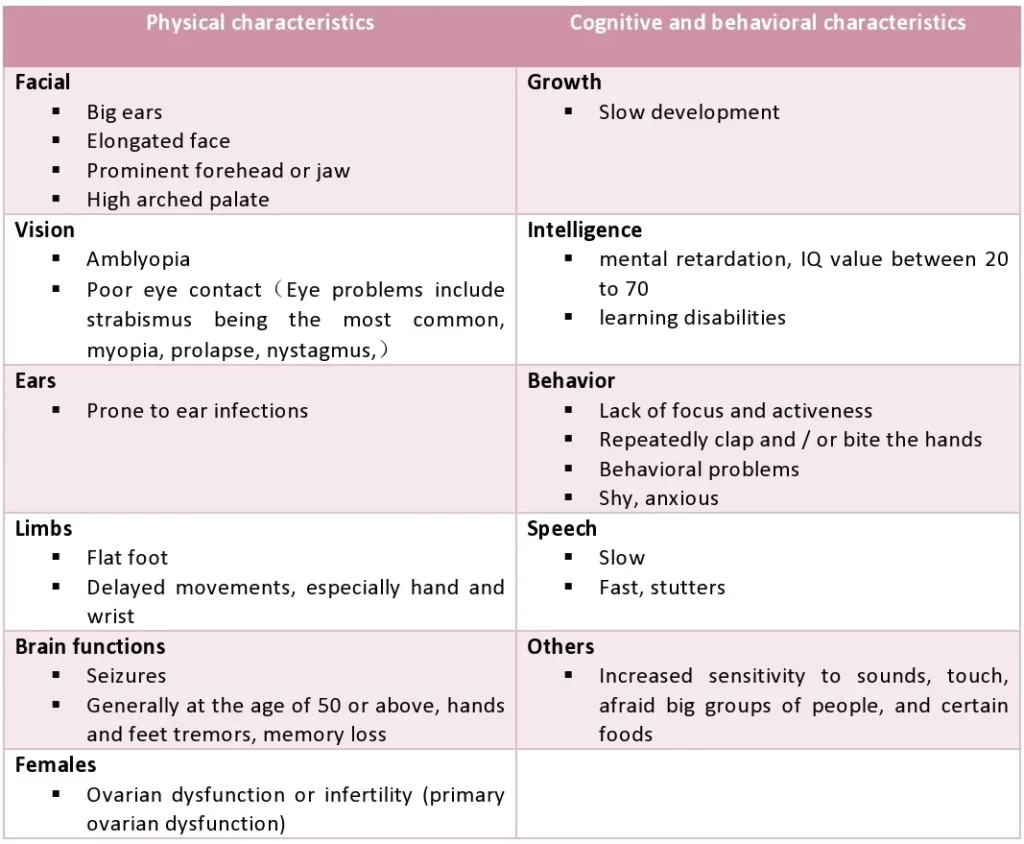
It is because if the expected mother is a carrier of an X-linked dominant disorder, there will be 50% chance of inheritance if the expected baby is a male. X-linked dominant disorders include diseases such as amblyopia, epilepsy, mental retardation and other diseases such as Fragile X syndrome. Fragile X syndrome is regarded the cause of different growth problems with regard to learning abilities as well as delayed development of speech. Therefore, by taking the Maternal Blood Y-DNA test, the sex of the expected baby can be verified. Expected parents can determine the necessity of taking further tests such as Fragile X Carrier Screening (MFX).
Our data base would be updated once an hour, please try an hour later.
The Y chromosome is one of two sex chromosomes (allosomes) in mammals, including humans, and many other animals. The other is the X chromosome. Y is the sex-determining chromosome in many species, since it is the presence or absence of Y that determines the male or female sex of offspring produced in sexual reproduction.
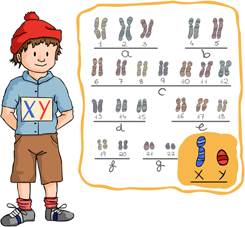
Source: Wikipedia
Clients, who are an organ transplant recipient, are not qualified to take the test. (DiagCor will NOT accept the case)
For Maternal Blood 70 Y-DNA Test report:
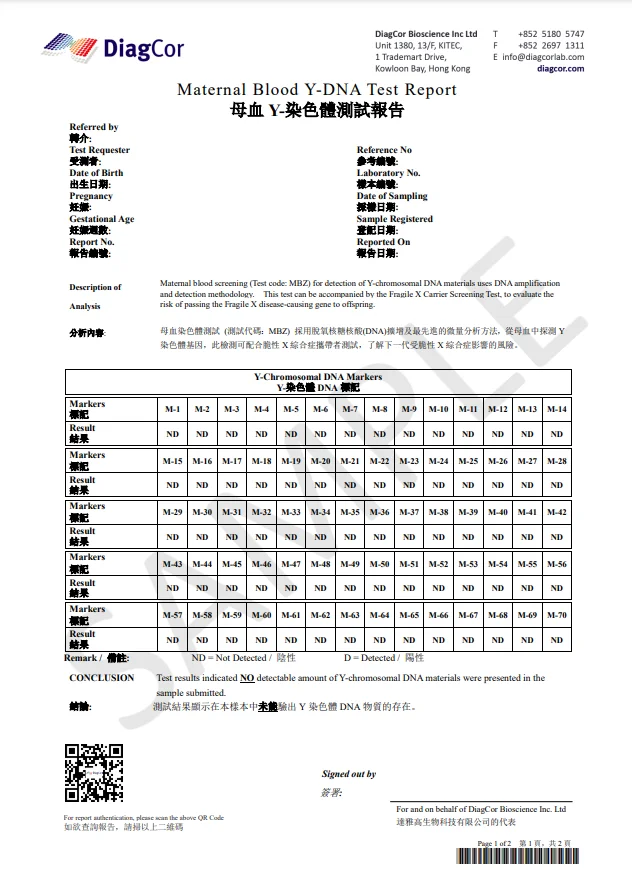
12ml of blood from the expected mother
The test methods are the same. For paternity test for legal purposes, samples must be collected at DiagCor Laboratory. All identity documents of the testees need to be checked and recorded. For paternity test without legal use, there is no restriction on the location of the sample collection, and there is no need to check the identity of the testees.
The report has two results:
1.Not excluded – most likely a biological father
2.Excluded – not a biological father
相同。因為同一體內的細胞都有相同的DNA。
並無限制。
沒有。達雅高生物科技有限公司總部在香港。而達雅高達雅高生物科技有限公司逮屬於新亞集團。
In about 5 working days after DiagCor receive all the samples.
1.Maternal blood Y-DNA test (MBY) should be done before conducting Y-chromosome DNA Exclusion (MBE). If the MBY test results indicate that there is a detectable amount of Y-DNA in the sample submitted, then the expected mother can proceed to take MBE test.
2.If there are more than one alleged fathers and they share the same paternal line (such as brothers, uncle & nephew, grandfather & grandson, etc.), the results would be “Non-Exclusion”.
7 weeks pregnant or above (subject to ultrasound examination)
No special precautions or preparations are needed. Fasting is not required as well.
In about 1 working day after DiagCor received all the samples
7 weeks pregnant or above (subject to ultrasound examination)
12ml blood of the expected mother
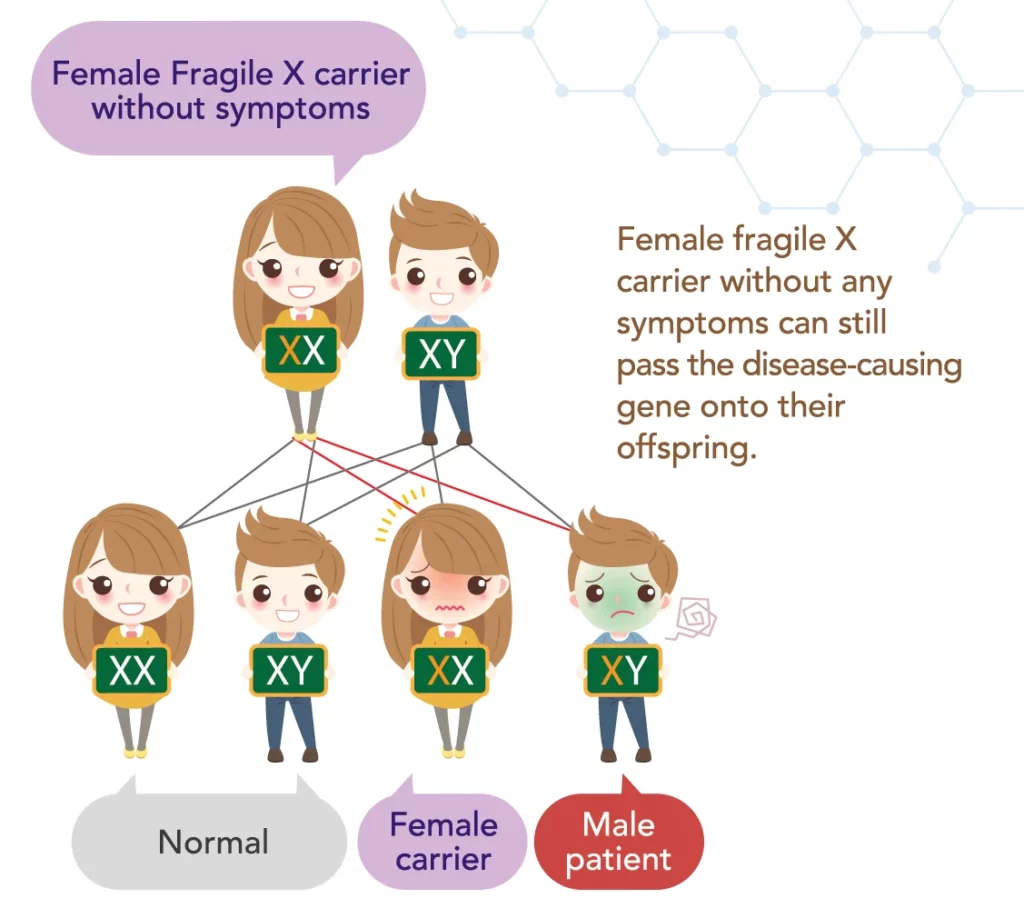
1.Even if women show no symptoms, they may still be carriers, and have chance to pass mutated gene towards their next generation.
2.If you give birth to a girl, she has chance to become a fragile X syndrome carrier. If you give birth to a boy, he has chance of being a fragile X syndrome patient.
The abovementioned claims can be explained in the following diagram: